
Cart
Your cart is empty
Looks like you haven’t added anything yet, browse new arrivals below!
Continue ShoppingLooks like you haven’t added anything yet, browse new arrivals below!
Continue ShoppingWhether you are shopping for yourself or for someone you care about, this glossary of adaptive footwear terms gives plain-English definitions of the words you will meet when looking for adaptive footwear. It covers walking terms such as gait and toe clearance, conditions that can affect walking, and fit and buying terms such as shoe width and health savings account (HSA) or flexible spending account (FSA) payment. Your physical therapist or doctor can help you apply them to your own situation.
In this glossary, you'll learn:
Jump to: # · A · B · C · D · E · F · G · H · I · J · K · L · M · N · O · P · Q · R · S · T · U · V · W · X · Y · Z
 |
Clinically reviewed by Nathan Estrada, DPT, VP Clinical and physical therapist at Cadense Physical therapist and healthcare executive focused on mobility and fall prevention for older adults. Nathan hosts Cadense's five-day video series, Getting Started with Your Cadense Adaptive Shoes. Follow Cadense on LinkedIn. |
Adaptive footwear is footwear designed around a specific walking or dressing challenge, not style alone. It may have a wide opening, easy fastenings, extra width or depth, or a sole shaped to ease a walking pattern such as toe drag.
Regular shoes are built for the average foot and stride. Adaptive footwear starts from the person's needs, such as a brace, swelling, dressing with one hand or a foot that does not lift fully. A physical therapist or doctor can help match features to your needs, and you can see how these features look across a range of adaptive shoes for walking difficulties.
AFO stands for ankle-foot orthosis, a brace worn on the lower leg and foot that controls the position and motion of the ankle. AFOs are used to control foot drop caused by a variety of neurologic and musculoskeletal disorders. Some are solid, some hinge at the ankle, and some are flexible.
Because the brace sits inside the shoe, it changes how a shoe must fit. The shoe needs a wide opening and extra room at the heel, ankle and instep, so many wearers need a larger size or a wider width than usual. Choose the width by the bulk of the brace, not your usual width, using an AFO shoe size guide, and see the range of AFO shoes made for braces.
Related terms: Foot Drop, Removable Shoe Fillers, Shoe Width.

Image from Cadense
Cerebral palsy is a brain disorder that appears in infancy or early childhood and permanently affects body movement and muscle coordination. It results from changes in the developing brain. These changes disrupt the brain's ability to control movement and maintain posture and balance. Its types include spastic, dyskinetic, ataxic, and mixed cerebral palsy.
Walking patterns vary widely. Some people walk on their toes or with an uneven stride. Many adults with cerebral palsy wear an AFO for stability, so their shoes need room for the brace.
Fear of falling is a lasting worry about losing your balance or tripping. It is common among older adults, even those who have never fallen. It can grow after a near-miss, after seeing someone else fall, after surgery or an illness, or with changes in strength or vision.
The worry can start a cycle, because moving less can lead to less strength and balance. Strength and balance exercises, such as tai chi, are commonly suggested to rebuild confidence and lower the chance of a fall. Talk with a physical therapist or doctor about any worry you have about falling.
Festinating gait is a walking pattern in which steps get faster and faster, which can make it hard to stop or slow down. It is seen in Parkinson's disease. A stooped, forward-leaning posture shifts the body's center of gravity forward, and the feet take quick, short steps to catch up.
This pattern is linked to a medical condition. Talk with a physical therapist or doctor about any change in how you or a loved one walks.
Foot drop, also called drop foot, is difficulty lifting the front of the foot as you walk. Doctors treat it as a sign of another health problem rather than a disease on its own. Causes include an injury to the peroneal nerve below the knee, a stroke, or Multiple Sclerosis.
Early signs can be easy to miss. Watch for scraping toes, more tripping, lifting the knee higher than usual, a foot that slaps down, or trouble walking on your heels. Treatment depends on the cause, and the most common approach is a brace called an AFO, often with exercises to keep the muscles strong. Footwear matters too, because a drooping toe catches easily on rugs and thresholds, so ask your therapist about shoes for foot drop, a brace, or both.
Related terms: Foot Slap, Steppage Gait, Toe Drag.
Foot slap, also called slap gait, happens when the foot slaps down on the ground instead of landing heel first and lowering smoothly. Foot drop and foot slap are not the same thing. Foot drop is the difficulty lifting the front of the foot, and foot slap is one way it shows up as the foot lands.
People often mix up these 3 walking patterns.
| Walking pattern | What it looks like |
| Foot slap | The foot slaps down instead of landing heel first |
| Steppage gait | The knee lifts higher than usual to keep the toes from scraping |
| Toe drag | The front of the foot scrapes along the ground during a step |
During an exam, a provider usually asks you to walk so they can watch your gait, which is often enough to tell these patterns apart.
Freezing of gait is a sudden, short inability to move the feet forward while walking. It is common in Parkinson's disease and is often set off by turns, tight spaces, or distractions.
Episodes usually pass within seconds. Physical therapists often teach cueing strategies to restart movement, such as stepping over a line on the floor or counting a steady beat. Talk with a physical therapist or doctor about freezing episodes, since they can help you plan for them.
Related terms: Festinating Gait, Shuffling Walk.
Gait is the way a person walks. Doctors and physical therapists look at gait to understand walking changes.
In a gait assessment, a physical therapist or physician watches how you walk to find what is behind a walking problem. Nerve or imaging tests are sometimes added. A normal gait cycle has 2 main phases. During stance, the foot is on the ground and bears weight. During swing, the foot moves forward through the air.
The table shows how a normal gait cycle divides into stance and swing.
| Gait phase | Share of a normal gait cycle | What happens |
| Stance | About 60% | The foot is on the ground and bears weight. |
| Swing | About 40% | The foot moves forward through the air. |
Related terms: Stance Phase, Swing Phase.
Hemiplegic gait is a walking pattern seen after a stroke or brain injury that affects one side of the body. The affected leg stays stiff and swings outward in an arc, called circumduction. The arm on that side is often held bent close to the body.
It goes along with hemiparesis, or weakness on one side, which can change stride length and weight shifting. Because the affected foot may not lift well, the toes can scrape during the swing, which is why this pattern often appears alongside foot drop. Ask your care team which footwear suits your walking.
Related terms: Foot Drop, Toe Drag.

Diagram created for Cadense
A health savings account (HSA) and a flexible spending account (FSA) let you pay for qualified medical expenses with tax-advantaged money. An HSA requires qualifying high-deductible health coverage. An FSA is usually set up through an employer.
A debit card from the account works like a regular card at checkout, and some retailers explain how shoes with HSA/FSA payment works. Whether an item is eligible depends on your plan's rules, so check with your plan administrator before you buy, and keep your receipts.
Multiple sclerosis (MS) is a condition in which the immune system attacks myelin, the protective coating on nerve fibers in the central nervous system. Many people with MS have difficulty with balance and walking.
Muscle weakness, stiffness, and spasms can also affect walking or standing, and foot drop is one of the walking changes people with MS may have. Symptoms vary from person to person and can change over time, so walking may feel different from one day to the next.
Parkinson's disease is a disorder of the nervous system that affects movement and gets worse over time. Walking changes can include small, shuffling steps, a forward-leaning posture, and reduced arm swing.
Some people also pause or freeze when starting to walk. Balance and gait training with a physical therapist is a common part of care, and your therapist can suggest strategies for turns, doorways and starting to walk.
Peripheral neuropathy is damage to the peripheral nerves, the nerves outside the brain and spinal cord. Symptoms can include pain and tingling, reduced sensation, and muscle weakness, often in the hands or feet.
When feet lose feeling, a person may not notice a pebble in a sock or a blister forming. For people with diabetes, the National Institute of Diabetes and Digestive and Kidney Diseases (NIDDK) advises checking the feet each evening when the shoes come off. It also suggests choosing a shoe size that fits your feet when they are largest, which is typically at the end of the day. A doctor can explain the cause and the care that suits you.
Removable shoe fillers are inserts that take up extra room inside a shoe so it fits more evenly. They are useful when feet differ in size, when swelling changes through the day, or when a brace takes up room in only one shoe.
Choose the shoe width for the bulkier foot first. Then add fillers to the other shoe, or to either shoe after sizing up, until the fit feels snug without pressing, and take them out when you need more room.
Related terms: AFO (Ankle-Foot Orthosis), Shoe Width.
A rocker sole has a curved shape that helps the foot roll forward from heel to toe.
The curve moves the point where the shoe bends, so the foot and ankle have to flex less, and it can lower pressure under the front of the foot. Rocker soles are often discussed for forefoot pain and diabetic foot care. They come in different shapes, so ask a podiatrist or physical therapist which shape suits your walking.
Related terms: Gait, Stance Phase.

Image from Cadense
Shoe width describes how roomy a shoe is from side to side. In US sizing it is shown as a letter after the size. A men's D and a women's B are the standard widths, and more letters, such as E, 3E or 6E, mean more room. Brands differ, so follow the brand's own width chart.
To measure, trace each foot, measure from the heel to the longest toe, and round to the closest size. If one foot is longer than the other, size to the larger measurement, and measure late in the day, when feet are largest. A sizing guide shows the steps.
The table shows typical US width letters.
| Width | Men's | Women's |
| Standard | D | B |
| Wide | E | C |
| Extra wide | 3E, 6E | 3E, 6E |
A shuffling walk is a walking pattern of small steps in which the feet stay close to the ground. People with Parkinson's disease may take small, shuffling steps, though shuffling can have other causes too.
Because the feet stay low, rugs and thresholds become trip points. If shuffling is new for you or someone you care for, ask a doctor to take a look.
The stance phase is the part of the gait cycle when the foot is on the ground and bears weight. It makes up about 60% of a normal gait cycle.
During stance, the heel strikes, the foot settles flat, the body moves over it, and the heel and then the toes push off. A weak ankle or leg can make this phase feel unsteady.
Related terms: Gait, Swing Phase.

Diagram created for Cadense
Steppage gait is a high-stepping walk. A person lifts the knee higher than usual so the toes clear the ground, and the foot may drag or slap down. It is associated with foot drop.
It is one of several ways people make up for a foot that won't lift. Others include hiking the hip or swinging the leg out to the side, called circumduction, as seen in hemiplegic gait. Lifting the knee with every step takes extra effort, which is why steppage gait can feel tiring.
Related terms: Foot Drop, Toe Clearance, Toe Drag.

Diagram created for Cadense
Stooped posture is a forward-leaning position in which the head, shoulders, and upper back curve forward. It is also called kyphotic posture, and it is one of the walking changes seen in Parkinson's disease. Common signs include the head sitting forward of the shoulders and rounded shoulders.
When the body leans forward, its center of gravity shifts, so each step can take more effort. A physical therapist can suggest exercises and check how your shoes suit your stance.
The swing phase is the part of the gait cycle when the foot is off the ground and moving forward. It makes up about 40% of a normal gait cycle.
When the front of the foot does not lift well, the toes may not clear the ground in this phase, which is where toe drag and toe-catch begin.
Related terms: Gait, Stance Phase, Toe Clearance.
Swollen feet happen when fluid builds up in the feet and ankles, which doctors call edema. Swelling can change during the day and is common among older adults and people with neuropathy.
When feet change size, narrow or rigid shoes can press and rub. Adjustable closures, enough width and depth, and removable fillers let a shoe adapt as swelling comes and goes. Ask a doctor about new or ongoing swelling, because it can be a sign of another health problem.
Related terms: Shoe Width, Peripheral Neuropathy, Removable Shoe Fillers.
Toe-catch is when the toes catch on the floor or an obstacle in the middle of a step, which can interrupt the stride. Rugs, curbs, and thresholds are common catch points.
Catches usually happen when the foot swings low, so clearing loose rugs and other tripping hazards at home lowers the chance of one. If you keep tripping, speak with a healthcare provider and check your footwear.
Toe clearance is the space between the toes and the ground as the foot swings forward. When clearance is low, the toes can catch on rugs, curbs, or uneven spots.
Fatigue, weakness, or a foot that does not lift fully can all reduce toe clearance.
Related terms: Swing Phase, Toe-Catch, Toe Drag.

Diagram created for Cadense
Toe drag happens when the front of the foot scrapes along the ground during a step instead of clearing it. Toe drag often goes along with foot drop.
To avoid catching the toes, some people lift the knee higher, a pattern called steppage gait. Scuffed or worn toe tips on shoes are an early sign of toe drag, and worth mentioning to a physical therapist.
A wide toe box gives the front of a shoe extra room for the toes to spread. It is not the same as a wide width: a shoe can give the toes room to move while keeping the heel and midfoot secure.
Look at depth as well as width, because toes also need height so the top of the shoe does not press on them. To check the fit, the NIDDK suggests choosing a shoe size that fits your feet when they are largest, which is typically at the end of the day.
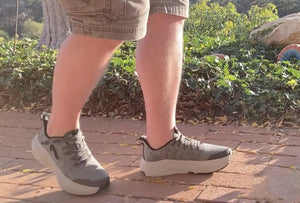
The Cadense Original adaptive sneaker will launch in the Winter of 2023. You can get VIP early access by signing up to our newsletter and you will also receive a complimentary gift with your purchase.
The Cadense Original Shoes will launch in the United States in the fall of 2023. Sign up for our newsletter and we will notify you when you can pre-order your pair.
You are in the right spot. Cadense shoes will first be available through our website cadense.com
The Cadense Original will be available in the following sizes and colors:
The Cadense Original will be offered at $198 a pair. All shoes include free delivery and a 30-day risk-free trial period. We also offer affordable monthly payment options.
The best way to get in touch with our team is through email. Simply send us a note to support@cadense.com