Skip to content
Find A Cadense Coach Location

Perks of the program

As a Cadense Coach, you’ll gain access to exclusive tools, education, and early research designed to support your clinical practice.

Coach benefits include:

  • Clinic sample pair for hands-on use with clients
  • Educational materials to share with patients
  • Free CEU-compliant training on Reduced Constraint Locomotor Therapy
  • Early access to new adaptive products
  • Opportunities to participate in beta studies
  • Direct input into future product development

Sign-Up form

CEU Course

Get access to a 2-hour CEU-compliant course designed for physical therapists working with patients who experience walking difficulties.

Learn the science, theory, and practical application of Reduced Constraint Locomotor Therapy—the clinical approach that inspired Cadense’s Variable Friction Technology.

  • 2 hours · CEU-compliant certificate
  • 7 chapters · 15 lessons
  • Taught by Meagan George, PT, DPT, NCS & Tyler Susko, PhD
  • Free for a limited time
Enroll here

Who is the Coaches Program For?

The Cadense Coaches Program is for clinicians who work with clients experiencing:

  • Difficulty clearing the foot during walking
  • Toe drag or scuffing
  • Hesitation, instability, or fatigue
  • Neurological or mobility-related gait challenges

Cadense Adaptive Shoes have been used successfully with clients affected by stroke, Multiple Sclerosis, Parkinson’s, peripheral neuropathy, cerebral palsy, and general lower-limb weakness.

How Cadense adaptive shoes help

Cadense shoes use a unique sole design that allows the foot to glide forward instead of catching, then naturally activates grip as weight is applied.

This helps:

  • Reduce trips and toe catch
  • Support smoother, more rhythmic walking
  • Increase confidence during movement
  • Provide both a training effect and an assistive benefit

Coach Education & Training

In this video, Dr. Tyler Susko explains the science behind Cadense Adaptive Shoes and how they support clients with walking difficulties.

Cues to Get Your Clients Started

This video provides practical cueing strategies for physical and occupational therapists when introducing Cadense Adaptive Shoes to clients.

Woman putting on white Cadense Original shoes

Recommended Gait Training Guidelines

Based on beta testing and ongoing clinical trials, we recommend:

  • At least 10–30 minutes of walking per day
  • 5 days per week
  • Over 1–6 months, depending on ability and goals

In our beta test, some participants increased walking duration significantly over time. One stroke participant progressed from 10 minutes per day to 40 minutes per day, with visible strength improvements on the affected side.

Helping Nervous Clients Get Started

We recommend the following progression:

  1. Master sit-to-stand
    Apply weight to the shoes before transitioning from seated to standing.
  2. Test the waters
    Slide the shoe on different surfaces, then apply weight to feel the transition to grip.
  3. Intentional sliding
    Ask the client to intentionally use the sliding feature on both feet during early walking attempts to build confidence.
  4. Normalize gait
    Transition to straight, symmetric steps without intentional scuffing.
  5. Build rhythm
    Walk to a beat. The sound of the sole on hard floors can provide helpful biofeedback.
  6. Increase speed and confidence
    Once gait becomes rhythmic and controlled, focus on pace and endurance.

For more guidance, visit our 5-day Getting Started Video Series:

getting started

Research Behind Cadense: A 12-Year Journey

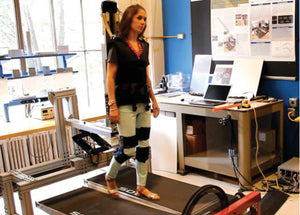
Person walking on MIT Skywalker

MIT Skywalker (2013–2016)

A robotic gait rehabilitation system designed to reduce ground interaction forces during walking, helping patients move more rhythmically and naturally.

Variable Friction Shoes at UCSB (2017–2019)

Over 30 shoe prototypes were developed to replicate reduced ground interaction during swing. Early testing showed improvements in walking speed and reduced compensatory movements within minutes for some users.

Commercialization & Beta Testing (2021–2022)

A 13-participant beta confirmed safety and usability outside the lab, with several users reporting therapeutic benefits over time.

Ongoing Clinical Research (2022–Present)

  • Shirley Ryan AbilityLab testing with stroke patients showed strong interest and positive feedback
  • NIH-funded 4-year clinical trial underway
  • Future studies planned for Parkinson’s, MS, and myositis

Join the Cadense Coaches Program — It’s Free

If you work with clients who struggle with walking and want access to innovative tools, education, and research-backed solutions, we’d love to partner with you.

Shopping Cart